Record
Copy input bytes into a workspace. Originals are not mutated. Each artifact gets a source label, actor, and job identity.
 +1 888 373 0322Contact
PRODUCT
Blackbox Systems is the receipt, manifest, signature, packet, and verification runtime for digital evidence. You deploy it beside forensic, eDiscovery, incident, archive, and provider-assurance work. You do not subscribe to a tenant.
DELIVERABLES
Record, bind, issue, verify. Each state stays independently inspectable after the originating process has ended. The product is the record those four states leave.
Copy input bytes into a workspace. Originals are not mutated. Each artifact gets a source label, actor, and job identity.
SHA-256 over file bytes. Chained V2 receipts with previous-record linkage. Crash-safe append and torn-tail handling.
Compile a packet only when scope, limitations, reviews, receipts, and manifests are present. Missing controls keep the packet DRAFT_ONLY or HOLD.
A reviewer recomputes hashes, checks signatures with public keys, and rejects undeclared ZIP entries without the originating runtime.
OPERATOR CLI
The PowerShell module is the operator surface. PowerShell 5.1 or 7. SHA-256 required. SHA-1 and MD5 only when requested. Manifests are ordered. Receipts are append-only NDJSON. State lives on the machine, not in a hosted account.
Create the local workspace under the operator machine. No network. No credentials.
Copy bytes in. Originals stay untouched.
Deterministic ordered SHA-256 manifest over the workspace.
Job object with a case id. Inputs attach to the job, not to a cloud tenant.
Hash, then export a packet. Receipts append. They do not rewrite history.
Read the chain. Run the module self-test on the same machine.
MEASUREMENT OPERATORS
The observation lane runs a fixed set of measurement operators over an artifact. Each reports a value and nothing more; turning a reading into a finding is a separate, graded step a person owns. A detection is a reading, not a conclusion.
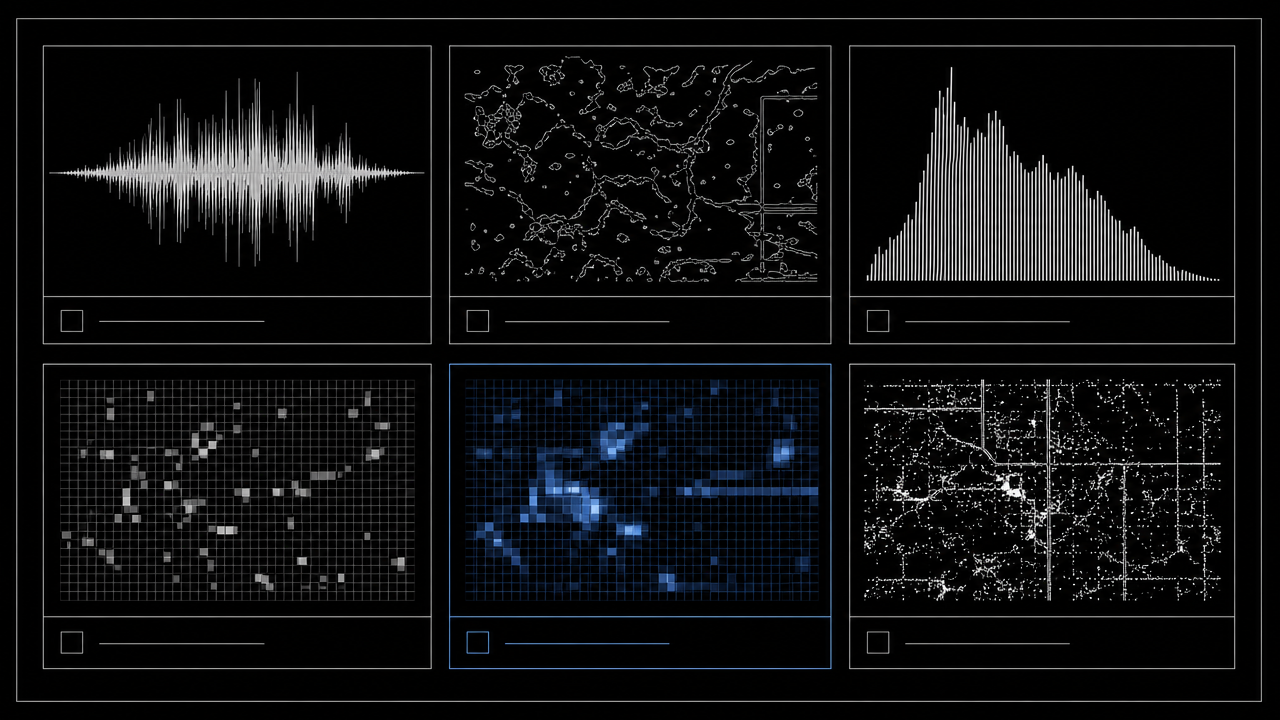
Reads compression-residual discontinuity across a frame. Regions that were resaved at a different quality than their surroundings stand out as a reading — not as an accusation.
Measures the tonal floor and transfer curve. A spliced region often carries a different black point or gamma than the plate it sits in; the operator reports the measurement and leaves the inference to a person.
Quantifies edge energy along region borders. A composited boundary deposits energy a native edge does not. The number is recorded; it is not graded here.
Counts saturated samples at the signal ceiling and floor. Clipping bounds what any later claim can honestly assert about the original — a limit, stated, not papered over.
Maps edge structure and the noise field. A region whose noise statistics do not match the frame is a reading worth a reviewer's attention, not a verdict the tool is entitled to reach.
Renders the signal envelope and sample distribution. The shape is the evidence; the operator presents it and declines to decide what it means.
MEASUREMENT, NOT RECONSTRUCTION
A studio restoration suite is built to make a recording clean. That is the opposite of what an examiner needs, and the difference is deterministic, not rhetorical.
A studio restoration suite — iZotope RX and its peers — exists to make a recording sound or look clean. It interpolates, attenuates, and resynthesizes until the artifact is gone. Admirable craft; the output is a new signal, not the original.
Measurement reads what is present and alters nothing. The bytes that entered are the bytes that are hashed, and the operator reports a value rather than improving the evidence. Whereas restoration removes the thing an examiner needs to see, measurement preserves it.
A reconstruction cannot be independently recomputed to the same result, because the result depended on choices the tool made and did not record. A deterministic measurement can: same bytes, same operator, same number, on anyone's machine. One is restoration. The other is forensics, and the difference is the whole product.
FROM MEASUREMENT TO MACHINE SIGHT
Run exhaustively, frame by frame, the operator readings become the training signal for the vision and reasoning lanes — producing real-time scan-style perception that still answers to forensic restraint. A reading is a candidate; agreement across independent method families and a named human make it a finding.
The operator stack runs over a clip frame by frame — spectrogram, edge, boundary-energy, distribution and the rest — at high compute. Every frame produces the same disciplined set of readings, so a sequence becomes a dense, labeled measurement field rather than a glance.
That per-frame field is the training signal fed to the vision and reasoning lanes. The model does not learn to guess; it learns the discipline the operators enforce — read, do not alter; candidate, not verdict. The rigor of the measurement is what the model inherits.
The result is real-time scan-style perception — detect, track, engage-proxy, assess, scored per pass against public-domain footage. It still never finds alone: a reading is promoted only when independent method families agree, and a named human owns the call. Machine sight, held to forensic restraint.
The discipline was first achieved on a phone — the operator passes implemented in Pythonista on mobile — before it was fed accelerated compute. If it holds on constrained hardware, scale is an amplifier, not a crutch.
AUDIO FORENSICS
The audio lane pairs transcription with the measured signal and runs recursive, high-compute passes: speaker diarization and isolation, deterministic equalization and calibration, seam and splice detection. It reports the differences and their measured basis; when a diff is substantial, review is left to the requesting legal party. Backed by a passing acoustic-measurement suite.
Speech-to-text runs beside the spectrogram, not instead of it. The transcript is a reading of what was said; the spectrogram is the measured signal underneath it. The two are kept together so a word is always answerable to the frequency evidence that produced it.
The clip is analyzed in repeated cycles — each pass refines the time-frequency decomposition and re-reads the segments the prior pass flagged. Nothing is smoothed away between passes; the recursion sharpens the measurement, it does not launder it.
The operators separate who-spoke-when and isolate a speaker's band from overlapping sources. Isolation is a view onto the existing signal, not a resynthesis of it: the isolated track is derived by measurement, and the original remains the hashed reference.
Equalization and calibration here are fixed, declared transforms applied to reveal, not to beautify. The same input and the same calibration produce the same output on any machine — so an adjustment that exposes a splice can be independently recomputed, which a discretionary studio EQ cannot.
Where passages differ — an edit boundary, a seam in the noise floor, a speaker who does not match the band around them — the system reports the difference and its measured basis. When a diff is substantial, it is handed to the requesting legal party for review. The tool states what differs; it does not declare what it means.
MOBILE FORENSIC SHORTCUTS
Field capture often starts on a phone or tablet before an artifact ever reaches a workstation. The mobile bridge binds files at the moment of selection on iOS and writes the same ordered SHA-256 manifests and state-freeze locks checked on desktop silicon.
iOS Files and Share Sheet intake computing SHA-256, SHA-1, and MD5 digests over selected document sets into paired BBS_FILE_HASH_MANIFEST JSON and text records (PRT-MOB-10.1-T, PRT-MOB-10.4-T, PRT-MOB-10.9-T).
Reference-directory state-freeze and drift verifier writing source_of_truth_lock.json with a deterministic state_root_sha256 commitment and per-run verification_result receipts (PRT-MOB-10.5-T, PRT-MOB-10.6-T).
Mobile abstract intake, deterministic build, freeze, and portable bundle generator for structured field notes and evidentiary summaries (PRT-MOB-10.2-T, PRT-MOB-10.3-T, PRT-MOB-10.7-T, PRT-MOB-10.8-T).
Nine machine-readable .shortcut_ir.json workflow definitions bridging iOS Shortcuts and Pythonista to the desktop verifier, backed by 269 passing tests and 23 subtests across the 16-package suite.
STANDALONE ONE-OFF UTILITIES
Alongside the full workspace runtime, Blackbox Systems ships zero-dependency standalone programs for single-purpose manifest generation, structured archive assembly, schema normalization, and cross-surface desktop release verification.
Zero-dependency standalone Python CLI and Tkinter desktop utility that walks a target folder and writes a deterministic cryptographic manifest for legal, forensic, and audit handoffs (CAT5F-01).
Deterministic evidence-archive builder that packages files into 01_Manifests, 02_Documentation, 03_Source_Files, and 04_Hashes with an embedded SHA-256 manifest (CAT5F-02).
Standalone CSV and Markdown header normalizer that maps heterogeneous export columns to a canonical schema while recording every transformation (CAT5F-03).
Cross-surface verification of the Reach 0.17.0 Windows desktop release (1,053 payload files, 574,930,434 bytes, state-freeze root 7d649e58281d9ceb5e44063fe68a15030136c230dad0dee0cbde3a7e481bd428 PASS), displayed at reach.mediatorsolutions.io.
ISSUED PACKET
If scope, non-authority notice, source index, limitation register, review records, receipts, manifest, or export hash is missing, the runtime loses delivery authority for that packet. The operator holds, revises, voids, or supersedes. The software does not silently ship a DRAFT as a release.
What the job claimed to cover and what was actually issued.
The packet does not certify truth, decide meaning, or replace professional judgment.
Job identity, scope, client label, and actor boundary.
Every file that entered the workspace, with hash and source label.
Where each artifact came from. Filename is not identity.
Known gaps, WARN and blocking limitations, still visible after export.
Operator review state. Unresolved blocking review kills delivery authority.
Declared payload universe and a hash of the issued archive.
IMPLEMENTED NOW
Chained V2 receipts. Deterministic hashing. Serialized crash-safe append. Detached Ed25519 signatures and public-key verification. Transactional signed journals. Legacy-boundary migration records. Detached release verification over a declared ZIP universe.
A committed one-million-case receipted assurance campaign. Later campaigns record 18 million successful cases across 72 × 250,000-case receipt sets, and 5 million successful cases across 20 × 250,000-case receipt sets. Split archives and SHA-256 ledgers remain in repository custody.
Default packet compilation is not claimed as on in every path. Signed-journal operational activation, key-provider adapters, rotation runbooks, and enterprise pilot controls remain separate work. Implemented is not default-on.
It does not certify truth. It does not decide meaning. It does not recommend a legal, accounting, or investigative conclusion. It does not send outbound messages. A successful verifier result means the presented material satisfied the contract being checked.
HOW IT IS SOLD
Mediator Solutions LLC is the contracting entity. Access is a scoped deployment: workspace policy, key custody, packet rules, and operator boundary. There is no public self-serve tenant and no sign-up form.
Discuss the handoff you actually run. Forensic lab to counsel. eDiscovery export. Incident package to insurer. Archive to a recipient. Provider-assurance proof. Blackbox sits at the handoff.
Mediator Solutions LLC: UEI R2KVBJF18MG6; CAGE code 26BW4. SAM.gov registration is Active, expiring October 8, 2027. APEX Accelerators engagement is underway. Registration does not establish certification, contract award, or solicitation-specific qualification.